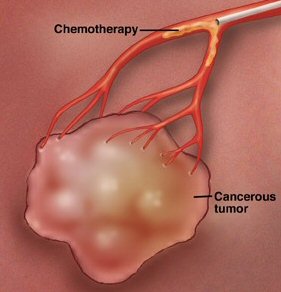
When Kistan2 asked in her Liver Cancer story about alternative liver cancer treatments, we immediately had to think about hepatocellular chemoembolization.
- chemo-embolization are 2 treatments in 1:
- a chemotherapy through the artery feeding the liver cancer +
- a closing of the above artery feeding the liver cancer

Immediately, because we went through the same quest when father was diagnosed with metastatic liver cancer. We searched the Internet for any cure, we found a few "promising treatments", but :
- they were extremely expensive, a long waiting list and not at all nearby
- they were promising because you tend to hold on believing in miracles
- they were all quite useless in our case because the doctors couldn’t find father’s primary cancer. In other words: even if we replaced the liver with a new one, the primary cancer sooner or later would attack it again (although nobody knows when, so you might say: if I can prolong my life with 5 extra years, why not…. Which is true, but the medical world doesn’t operate like you think…)
- one doctor even told us to stop reading the Internet and spend as much quality time as possible with father…
What is Hepatocellular Chemoembolization?
Chemoembolization is an innovative treatment for cancers of the liver doing 2 things at the same time:
- block the tumors’ blood supply and at the same time
- deposit a concentrated form of chemotherapy at the site of the cancer.
A catheter (a thin flexible, spaghetti sized tube) is placed through a tiny hole in the skin and directed through the pathways of the body’s arteries straight into the portion of the liver where the cancer is located.
Chemotherapy and particles which block the blood supply are then infused through this catheter.
Advantages of hepatocellular chemoembolization
Fist and foremost: it is a chemotherapy, so it’s not a guaranteed cure.
It is also used to reduce the size of the tumor to decrease the pain due to the growing liver pushing against the other organs.
The main advantage is that the chemotherapy doesn’t go into the entire bloodstream, so a higher dose can be used without the patient suffering from terrible side-effects if this dose was given with a normal chemo-therapy.
How does that work exactly you say? Well: the liver gets his blood:
- 75% from the so called portal vein
- 25% from the so called hepatic artery
Tumors in the liver typically get most of their blood supply from the hepatic artery. So:
- drugs or embolic material injected into the hepatic artery kill or greatly inhibit the tumor and
- spare most of the healthy liver tissue that is fed via the portal vein.
In father’s metastatic liver cancer case unfortunately: his liver didn’t have 1 big tumor, but looked like a raisin bread filled with little tumors. Trying hepatocellular chemoembolization would have been a daunting task…
Dear Ilyas,
Sorry for the late reply.
Our advice is that if possible you ask your medical questions to a team of doctors experienced in esophageal cancer that has spread to the liver.
Hugs, love and prayers,
SK
Dear sirs,
I want your guidance regarding the Liver metastatic.
My mother aged 52 years old diagnosed the esophageal cancer in April-2011 and the tissue was in big size at the junction of stomach and esophagous. Doctors Adviced us for the sugery.The surgery was done successfully on 2nd May 2011 and tissue was completly removed with esophagous part removal and stomach was pulled up for new tube for feeding.
In July 2011 once again C.T Scan was done which shown the liver metastatics. Then Oncologist advice us for Chemotheraphy treatment on weekly basis. (Taxol and carboplatin).After completion of 12 weeks(4 cycles) once again C.T scan done which report shown the decrease in the large size of mets which means the treatment responded. Doctor Adviced for more 2 cycles(6weeks) of treatment.In December total 6 cycles (18 weeks)of treatment was completed and now C.T Scan shows not changed in the mets of Liver as compared to last report which was done after 12 weeks (4cycles).
Doctor adviced us for more chemotherapy on same dose. However i believe that the dose may be changed.Sir, In this regard we want your expert advice and guidance that what should we do more for fight against this disease?
awaiting for your prompt response
Regards,
M.Ilyas Farooq